In purchased services, fragmented supplier management is costing hospitals millions—new tools make fragmented spend visible & actionable
Many health systems lack tools and resources to address Purchased Services contracting, which accounts for 50% of non-labor spend on average. CoxHealth was no different. To address this, it launched a three-year engagement with Valify Advisory in 2024. While the chief supply chain officer (CSCO) and contracting manager were focused on supply chain strategy and medical supplies, neither had the time to examine purchased services in depth. Valify Advisory brought the technology and subject matter expertise to focus on Purchased Services and encouraged CoxHealth to hire its own resource. Chris Bryant, experienced in healthcare leadership but new to supply chain, stepped into the role of Director of Strategic Sourcing.
“After the official engagement with Valify ends, we’ll continue to reap the benefits from the structure we’ve put in place.”
Chris Bryant

Working with Bryant, Valify Advisor brought structure, tools and expertise. “Most hospital purchasing teams just don’t have the bandwidth to really capitalize on these opportunities. Valify provides that help and support,” says Andy Motz, Vice President of Valify Advisory Services.
One of the first and biggest wins in 2025 was helping CoxHealth avoid a $750K capital purchase to replace its printing devices and infrastructure. The six-hospital, 80-clinic system in southwest Missouri had been managing all printing in-house, using laser printers and multifunctional devices operated by a non-HealthTrust supplier. The expenditure seemed unavoidable—until a Valify Advisory review completely changed the picture.
Instead of spending $750K, CoxHealth found that a contracted HealthTrust provider could eliminate the capital investment altogether and reduce ongoing costs by another $350,000 per fiscal year.
Purchased services—everything that keeps hospitals functioning but isn’t a drug, device or surgical supply—represent an enormous slice of operating expenses. This category spans food and nutrition, environmental services, translation, laundry, office supplies, elevator maintenance, print management and more. Yet, in many health systems, oversight of these services is fractured across departments, making it easy for inefficiencies and duplicated spend to compound unnoticed.
And the numbers add up quickly. In large organizations, the lack of centralized coordination can mean tens to hundreds of millions of dollars spent on redundant suppliers, inconsistent contract terms or unmanaged service agreements.
A structured approach
The turning point for CoxHealth came when its CSCO realized that purchased services were a significant blind spot during discussions with Valify. Departments were negotiating contracts independently, and the same supplier might be providing different services across multiple areas without anyone realizing it.
“No one knew that Engineering was using them for one thing, and Environmental Services was using them for something else,” Bryant recalls.
Building a framework for control
Through weekly meetings with Motz, Abbi Elzinga (HealthTrust Performance Solutions) and a dedicated project manager, Bryant began learning how to manage this sprawling category: setting priorities, reviewing contract compliance, building a savings pipeline, structuring negotiations and using Valify’s analytics.
“The tools take all of our purchased services spend and break it down into categories,” he explains. These insights help identify which categories offer the greatest financial opportunity and where duplicative or non-compliant contracts may sit.
“The benchmarking tools consider the financial opportunities & contract compliance…to help the healthcare system determine its savings goals.”
Andy Motz

Valify’s engagement model is intentionally designed to shift responsibility over time. Year by year, organizations build stronger internal processes— eventually creating a mature purchased services program that includes sourcing strategies, contract templates and a predictable renewal cadence.
“You’re not just fixing today’s problems,” Motz says. “You’re building a system that prevents them from coming back.”
Lessons that change behavior
Part of the engagement process is education, which can pay dividends over the long run. When Motz initially used Valify Insights to compare CoxHealth’s current 12-month spend to its previous 12-month spend, he saw a 20% variance in one category. Bryant dug deeper and uncovered the reason: A newly purchased surgical robot carried a service agreement negotiated without supply chain involvement.
“Any time you buy large pieces of equipment, you should work with your supply chain or contracting team on the front end to get a better deal,” Motz says. If not, once warranties expire, the leverage disappears.
This was a practice-changing lesson for CoxHealth. “It helped the entire system understand when it is appropriate to contact the supply chain office and who should be involved,” Bryant says.
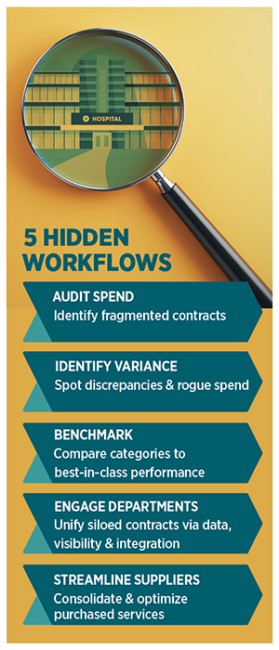 Making costs visible
Valify Insights is a suite of tools that highlights year-over-year spending variances, helping healthcare organizations take better control of their purchased services. Some projects are simple switches, and some involve more effort to reach the optimum results.
Bryant says one easy project was the organization’s paint contract. CoxHealth already worked with the paint supplier, but reached out to the company through its HealthTrust contract. The health system continues to work with its local store, but by switching from no contract to a HealthTrust contract, the health system saved $20,000 annually. “That happened with a couple of suppliers,” Bryant says, including those used for anesthetic gas, kids’ stickers, and building and office supplies.
More complex categories involve multiple stakeholders and often touch patient experience. With Valify’s help, another HealthTrust member consolidated from three suppliers to one—generating more than $10 million in annual savings.
But consolidation isn’t always the answer. Take interpretation services, for example. “Because of rare languages, you need backups,” Motz says. One system saved $2 million a year by reducing suppliers—but not expecting a single interpretation supplier could meet all their language needs.
Valify’s new Insights module
The recently enhanced Valify Insights module gives executives a snapshot of where costs are rising and where duplicate suppliers exist. Valify created a proprietary scoring system for purchased services categories. The Valify Score indicates what categories should be in scope, which categories should have a higher priority, and how they compare across the system or hospital.
“Valify Insights points leaders toward the categories that need attention, where multiple suppliers are providing the same services,” Motz explains.
The tool encourages broad access across the health system: CFOs, facilities managers, lab directors and others can use Valify Insights to understand spending patterns relevant to their operations.
A systemwide shift in mindset
Bryant urges other health systems to explore engaging with Valify to at least review their purchased services spend. The discovery process alone proved revealing. “There have been instances where we have the same supplier being used across the system by three different hospitals, and no one knew that.”
The stakes are significant. CoxHealth exceeded its first-year goal, saving more than $1 million. In year two, Bryant estimates another $2 million in potential savings.
According to Bryant, the effort quickly paid for itself. “It is worth it, given the millions we’re potentially going to save. After the official engagement with Valify ends, we’ll continue to reap the benefits of the structure we’ve put in place.”
For organizations not seeking a full engagement, Valify can still conduct an assessment to help focus on high-impact purchased services. The advisory service requires no upfront cost. “We’re truly a business partnership. We don’t make money unless we save you money,” Motz shares. “We’re at risk and we work to get you as much in savings as possible.”
From Bryant’s perspective, the message is clear: Health systems seeking savings must evaluate purchased services. “It’s that simple; there are significant savings out there.”
Drive value in purchased services for your organization by contacting the Valify Client Success team today at info@getvalify.com
Share Email Operations, Purchased Services, Q1 2026, Savings, Valify